24SevenOffice is a Norwegian software company headquartered in Oslo, Norway, with offices in Stockholm, Sweden and London, United Kingdom. Founded in 1997, the company specializes in web-based (SaaS) ERP and CRM systems. == Company history == 24SevenOffice was founded in 1997 in Porsgrunn, Norway, as IKT Interactive AS and marketed as kontorplassen.no. The name "24SevenOffice" was introduced for the company's London branch when the company entered the British market in 2003. The company changed its name to 24SevenOffice in February 2005. Originally based in Skien, the company later moved to Oslo Innovation Center, then to Tjuvholmen in the waterfront Fjord City of Oslo, and now the headquarters are located in Inkognitogaten 33, Solli plass, Oslo. The idea for the company's product was developed in 1996, and 24SevenOffice was an early innovator in the Scandinavian market in web-based enterprise resource planning solutions (ERP). A British office was established at Surrey Business Park in May 2003, with the company launching its web-based (SaaS) utility computing system to the UK SME market in 2004. An office in Chennai, India, was established in 2005, and 24SevenOffice entered the Swedish market when they acquired the leading competitor and ERP-provider Start & Run in a cash deal. In August 2005, the company had an initial public offering that raised NOK 15 million, and the company entered The Norwegian Over the Counter Market list as of 5 October 2005 (the ticker was 24SO), reaching a market value of NOK 175 million, with 5000 customers in Norway. In 2006, the company signed a deal to sponsor rally driver Petter Solberg, at the time the largest private sponsorship in Norwegian sport. Instead of receiving NOK 5 million in cash, Solberg received a 2.9 per cent ownership in the company. The company entered the German-speaking market in April 2006 when an office in Frankfurt am Main was opened. In late August/early September, they established an office with ten sales agents plus a general manager in Stockholm for the Swedish market. 24SevenOffice initiated strategic cooperation with Active 24 in early 2006 to develop a common platform. During the summer, Active 24 was bought by 24SevenOffice's ERP/CRM competitor Mamut (company), and 24SevenOffice terminated the contract with Active 24 in October demanding NOK 200 million in compensation for lost revenue. After a breakdown of settlement negotiations in the Forliksråd in January 2007, 24SevenOffice filed a case against Active 24 for breach of agreement in the Oslo District Court in March. 24SevenOffice lost on all counts in the District Court in December 2007. In January 2008, 24SevenOffice appealed the case to the Borgarting Court of Appeal, reducing the cause of action from NOK 250 to 30 million. 24SevenOffice lost on all counts in the Court of Appeal in December 2008, and was ordered to cover the costs incurred by Active 24 in connection with the dispute totaling NOK 6.91 million. 24SevenOffice appealed the case to the Supreme Court of Norway, but the Supreme Court Appeals Committee in March 2008 unanimously rejected the appeal from 24SevenOffice over the Borgarting Appeal Court's unanimous judgment of December 2008. On a counterclaim from Active 24 and Mamut against 24SevenOffice, the Oslo District Court in May 2010 found, that 24SevenOffice should pay Active 24 NOK 12 million in compensation for wrongfully having terminated the agreement, and a further NOK 360.000 of the opponent's legal costs. 24SevenOffice disagreed with the court ruling, and appealed once again. The Borgarting Court of Appeal in November 2011, ruled to reduce the amount of damages to NOK 4.4 million plus NOK 900.000 in penal interest. With several scrip issues, 24SevenOffice raised 25 million NOK (about $4 million at the time) between October 2005 and July 2006. They entered into a strategic partnership with Bluegarden, who for 30 years had delivered digital services for payroll, human resource planning, recruitment and training, in March 2006, and they made a large-scale agreement in April 2006, with US telecommunications software company Webex, a competitor to Norwegian Tandberg videoconferencing equipment manufacturer. In September 2006, 24SevenOffice signed an agreement with Fokus Bank to provide their customers with extended functionality in Internet banking. 24SevenOffice had by 2007 reportedly 9000 customers, joined the OpenAjax Alliance, and entered into a strategic partnership with Dun & Bradstreet in May 2007, but despite getting listed on Oslo Axess on 22 June (ticker: TFSO), reaching a market capitalization of NOK 120 million, the company was still losing money. The company ended 2007 with a revenue of NOK 21.7 million. In 2008, 24SevenOffice bought 50% of the stocks in telecommunication company Oyatel, partnered with Nets Group to facilitate invoicing for businesses, and telecommunications company Telipol chose 24SevenOffice's second-generation Internet platform for its 8,000 users. They announced an increase in revenues in Q2 to 11.1 million, up from 4.7 million in the same period the year before. 24SevenOffice had a turnover of NOK 37 million in the first half of 2009, a doubling compared to the same period the previous year, and presented its first positive EBITDA in Q2. The Norwegian Association of Auditors signed an agreement with 24SevenOffice in 2011, whereby they only recommend 24SevenOffice as a system for their members to use. On 27 June 2013, the shareholders of 24SevenOffice took off from the stock exchange and privatized the company. In recent years, the company has invested heavily in finance and accounting – and got leading auditing companies such as PwC and KPMG on the customer list. == Products == 24SevenOffice is a web-based (SaaS) ERP system. It includes modules for CRM, accounting, invoicing, e-mail, file/document management and project management. == Awards == 24SevenOffice won the Seal of Excellence in Multimedia Award at the 2004 CeBIT, became Norwegian Gazelle Company of the year 2004, chosen by Dagens Næringsliv and Dun & Bradstreet, won Product of the Year in the Norwegian finance magazine Kapital, and the IKT Grenland Innovation Award in 2008.
Apprenticeship learning
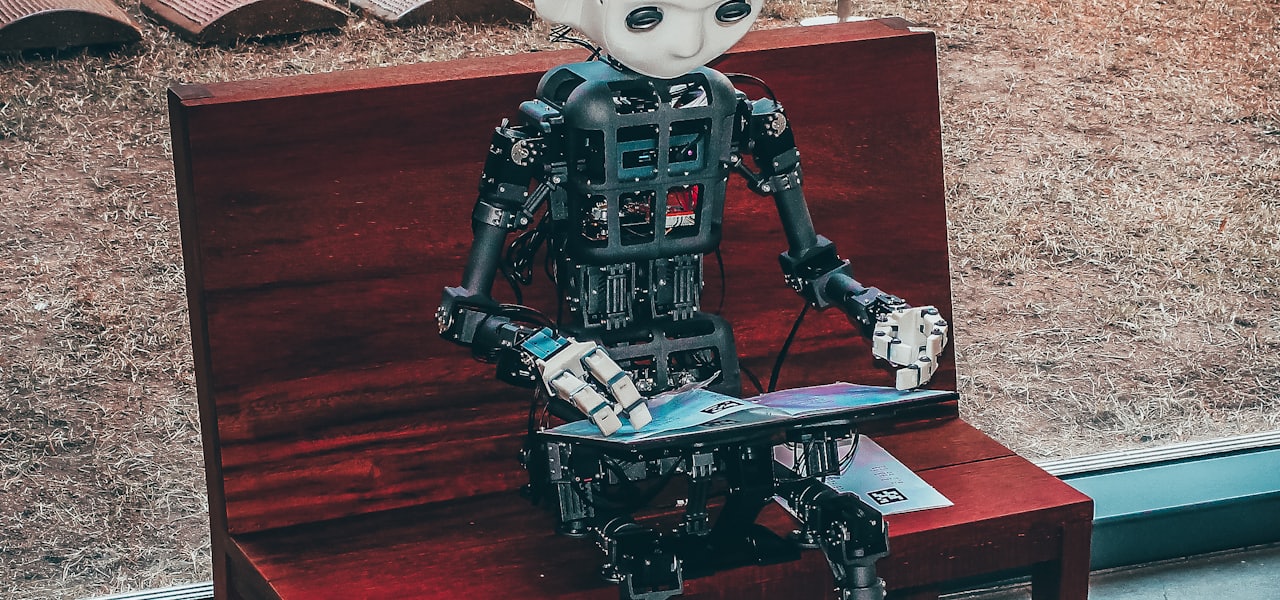
In artificial intelligence, apprenticeship learning (or learning from demonstration or imitation learning) is the process of learning by observing an expert. It can be viewed as a form of supervised learning, where the training dataset consists of task executions by a demonstration teacher. == Mapping function approach == Mapping methods try to mimic the expert by forming a direct mapping either from states to actions, or from states to reward values. For example, in 2002 researchers used such an approach to teach an AIBO robot basic soccer skills. === Inverse reinforcement learning approach === Inverse reinforcement learning (IRL) is the process of deriving a reward function from observed behavior. While ordinary "reinforcement learning" involves using rewards and punishments to learn behavior, in IRL the direction is reversed, and a robot observes a person's behavior to figure out what goal that behavior seems to be trying to achieve. The IRL problem can be defined as: Given 1) measurements of an agent's behaviour over time, in a variety of circumstances; 2) measurements of the sensory inputs to that agent; 3) a model of the physical environment (including the agent's body): Determine the reward function that the agent is optimizing. IRL researcher Stuart J. Russell proposes that IRL might be used to observe humans and attempt to codify their complex "ethical values", in an effort to create "ethical robots" that might someday know "not to cook your cat" without needing to be explicitly told. The scenario can be modeled as a "cooperative inverse reinforcement learning game", where a "person" player and a "robot" player cooperate to secure the person's implicit goals, despite these goals not being explicitly known by either the person nor the robot. In 2017, OpenAI and DeepMind applied deep learning to the cooperative inverse reinforcement learning in simple domains such as Atari games and straightforward robot tasks such as backflips. The human role was limited to answering queries from the robot as to which of two different actions were preferred. The researchers found evidence that the techniques may be economically scalable to modern systems. Apprenticeship via inverse reinforcement learning (AIRP) was developed by in 2004 Pieter Abbeel, Professor in Berkeley's EECS department, and Andrew Ng, Associate Professor in Stanford University's Computer Science Department. AIRP deals with "Markov decision process where we are not explicitly given a reward function, but where instead we can observe an expert demonstrating the task that we want to learn to perform". AIRP has been used to model reward functions of highly dynamic scenarios where there is no obvious reward function intuitively. Take the task of driving for example, there are many different objectives working simultaneously - such as maintaining safe following distance, a good speed, not changing lanes too often, etc. This task, may seem easy at first glance, but a trivial reward function may not converge to the policy wanted. One domain where AIRP has been used extensively is helicopter control. While simple trajectories can be intuitively derived, complicated tasks like aerobatics for shows has been successful. These include aerobatic maneuvers like - in-place flips, in-place rolls, loops, hurricanes and even auto-rotation landings. This work was developed by Pieter Abbeel, Adam Coates, and Andrew Ng - "Autonomous Helicopter Aerobatics through Apprenticeship Learning" === System model approach === System models try to mimic the expert by modeling world dynamics. == Plan approach == The system learns rules to associate preconditions and postconditions with each action. In one 1994 demonstration, a humanoid learns a generalized plan from only two demonstrations of a repetitive ball collection task. == Example == Learning from demonstration is often explained from a perspective that the working Robot-control-system is available and the human-demonstrator is using it. And indeed, if the software works, the Human operator takes the robot-arm, makes a move with it, and the robot will reproduce the action later. For example, he teaches the robot-arm how to put a cup under a coffeemaker and press the start-button. In the replay phase, the robot is imitating this behavior 1:1. But that is not how the system works internally; it is only what the audience can observe. In reality, Learning from demonstration is much more complex. One of the first works on learning by robot apprentices (anthropomorphic robots learning by imitation) was Adrian Stoica's PhD thesis in 1995. In 1997, robotics expert Stefan Schaal was working on the Sarcos robot-arm. The goal was simple: solve the pendulum swingup task. The robot itself can execute a movement, and as a result, the pendulum is moving. The problem is, that it is unclear what actions will result into which movement. It is an Optimal control-problem which can be described with mathematical formulas but is hard to solve. The idea from Schaal was, not to use a Brute-force solver but record the movements of a human-demonstration. The angle of the pendulum is logged over three seconds at the y-axis. This results into a diagram which produces a pattern. In computer animation, the principle is called spline animation. That means, on the x-axis the time is given, for example 0.5 seconds, 1.0 seconds, 1.5 seconds, while on the y-axis is the variable given. In most cases it's the position of an object. In the inverted pendulum it is the angle. The overall task consists of two parts: recording the angle over time and reproducing the recorded motion. The reproducing step is surprisingly simple. As an input we know, in which time step which angle the pendulum must have. Bringing the system to a state is called “Tracking control” or PID control. That means, we have a trajectory over time, and must find control actions to map the system to this trajectory. Other authors call the principle “steering behavior”, because the aim is to bring a robot to a given line.
Nearest neighbor search
Nearest neighbor search (NNS), as a form of proximity search, is the optimization problem of finding the point in a given set that is closest (or most similar) to a given point. Closeness is typically expressed in terms of a dissimilarity function: the less similar the objects, the larger the function values. Formally, the nearest neighbor (NN) search problem is defined as follows: given a set S of points in a space M and a query point q ∈ M {\displaystyle q\in M} , find the closest point in S to q. Donald Knuth in volume 3 of The Art of Computer Programming (1973) called it the post-office problem, referring to an application of assigning to a residence the nearest post office. A direct generalization of this problem is a k-NN search, where we need to find the k closest points. Most commonly M is a metric space and dissimilarity is expressed as a distance metric, which is symmetric and satisfies the triangle inequality. Even more common, M is taken to be the d-dimensional vector space where dissimilarity is measured using the Euclidean distance, Manhattan distance or other distance metric. However, the dissimilarity function can be arbitrary. One example is asymmetric Bregman divergence, for which the triangle inequality does not hold. == Applications == The nearest neighbor search problem arises in numerous fields of application, including: Pattern recognition – in particular for optical character recognition Statistical classification – see k-nearest neighbor algorithm Computer vision – for point cloud registration Computational geometry – see Closest pair of points problem Cryptanalysis – for lattice problem Databases – e.g. content-based image retrieval Coding theory – see maximum likelihood decoding Semantic search Vector databases, where nearest-neighbor lookup over embeddings is used to retrieve semantically similar records Retrieval-augmented generation systems, where nearest-neighbor retrieval over embeddings is used to fetch candidate passages or documents before generation Data compression – see MPEG-2 standard Robotic sensing Recommendation systems, e.g. see Collaborative filtering Internet marketing – see contextual advertising and behavioral targeting DNA sequencing Spell checking – suggesting correct spelling Plagiarism detection Similarity scores for predicting career paths of professional athletes. Cluster analysis – assignment of a set of observations into subsets (called clusters) so that observations in the same cluster are similar in some sense, usually based on Euclidean distance Chemical similarity Sampling-based motion planning == Methods == Various solutions to the NNS problem have been proposed. The quality and usefulness of the algorithms are determined by the time complexity of queries as well as the space complexity of any search data structures that must be maintained. The informal observation usually referred to as the curse of dimensionality states that there is no general-purpose exact solution for NNS in high-dimensional Euclidean space using polynomial preprocessing and polylogarithmic search time. === Exact methods === ==== Linear search ==== The simplest solution to the NNS problem is to compute the distance from the query point to every other point in the database, keeping track of the "best so far". This algorithm, sometimes referred to as the naive approach, has a running time of O(dN), where N is the cardinality of S and d is the dimensionality of S. There are no search data structures to maintain, so the linear search has no space complexity beyond the storage of the database. Naive search can, on average, outperform space partitioning approaches on higher dimensional spaces. The absolute distance is not required for distance comparison, only the relative distance. In geometric coordinate systems the distance calculation can be sped up considerably by omitting the square root calculation from the distance calculation between two coordinates. The distance comparison will still yield identical results. ==== Space partitioning ==== Since the 1970s, the branch and bound methodology has been applied to the problem. In the case of Euclidean space, this approach encompasses spatial index or spatial access methods. Several space-partitioning methods have been developed for solving the NNS problem. Perhaps the simplest is the k-d tree, which iteratively bisects the search space into two regions containing half of the points of the parent region. Queries are performed via traversal of the tree from the root to a leaf by evaluating the query point at each split. Depending on the distance specified in the query, neighboring branches that might contain hits may also need to be evaluated. For constant dimension query time, average complexity is O(log N) in the case of randomly distributed points, worst case complexity is O(kN^(1-1/k)) Alternatively the R-tree data structure was designed to support nearest neighbor search in dynamic context, as it has efficient algorithms for insertions and deletions such as the R tree. R-trees can yield nearest neighbors not only for Euclidean distance, but can also be used with other distances. In the case of general metric space, the branch-and-bound approach is known as the metric tree approach. Particular examples include vp-tree and BK-tree methods. Using a set of points taken from a 3-dimensional space and put into a BSP tree, and given a query point taken from the same space, a possible solution to the problem of finding the nearest point-cloud point to the query point is given in the following description of an algorithm. (Strictly speaking, no such point may exist, because it may not be unique. But in practice, usually we only care about finding any one of the subset of all point-cloud points that exist at the shortest distance to a given query point.) The idea is, for each branching of the tree, guess that the closest point in the cloud resides in the half-space containing the query point. This may not be the case, but it is a good heuristic. After having recursively gone through all the trouble of solving the problem for the guessed half-space, now compare the distance returned by this result with the shortest distance from the query point to the partitioning plane. This latter distance is that between the query point and the closest possible point that could exist in the half-space not searched. If this distance is greater than that returned in the earlier result, then clearly there is no need to search the other half-space. If there is such a need, then you must go through the trouble of solving the problem for the other half space, and then compare its result to the former result, and then return the proper result. The performance of this algorithm is nearer to logarithmic time than linear time when the query point is near the cloud, because as the distance between the query point and the closest point-cloud point nears zero, the algorithm needs only perform a look-up using the query point as a key to get the correct result. === Approximation methods === An approximate nearest neighbor search algorithm is allowed to return points whose distance from the query is at most c {\displaystyle c} times the distance from the query to its nearest points. The appeal of this approach is that, in many cases, an approximate nearest neighbor is almost as good as the exact one. In particular, if the distance measure accurately captures the notion of user quality, then small differences in the distance should not matter. ==== Greedy search in proximity neighborhood graphs ==== Proximity graph methods (such as navigable small world graphs and HNSW) are considered the current state-of-the-art for the approximate nearest neighbors search. The methods are based on greedy traversing in proximity neighborhood graphs G ( V , E ) {\displaystyle G(V,E)} in which every point x i ∈ S {\displaystyle x_{i}\in S} is uniquely associated with vertex v i ∈ V {\displaystyle v_{i}\in V} . The search for the nearest neighbors to a query q in the set S takes the form of searching for the vertex in the graph G ( V , E ) {\displaystyle G(V,E)} . The basic algorithm – greedy search – works as follows: search starts from an enter-point vertex v i ∈ V {\displaystyle v_{i}\in V} by computing the distances from the query q to each vertex of its neighborhood { v j : ( v i , v j ) ∈ E } {\displaystyle \{v_{j}:(v_{i},v_{j})\in E\}} , and then finds a vertex with the minimal distance value. If the distance value between the query and the selected vertex is smaller than the one between the query and the current element, then the algorithm moves to the selected vertex, and it becomes new enter-point. The algorithm stops when it reaches a local minimum: a vertex whose neighborhood does not contain a vertex that is closer to the query than the vertex itself. The idea of proximity neighborhood graphs was exploited in multiple publications, including the seminal paper by Arya and Mount, in the VoroNet syst
Autoencoder
An autoencoder is a type of artificial neural network used to learn efficient codings of unlabeled data (unsupervised learning). An autoencoder learns two functions: an encoding function that transforms the input data, and a decoding function that recreates the input data from the encoded representation. The autoencoder learns an efficient representation (encoding) for a set of data, typically for dimensionality reduction, to generate lower-dimensional embeddings for subsequent use by other machine learning algorithms. Variants exist which aim to make the learned representations assume useful properties. Examples are regularized autoencoders (sparse, denoising and contractive autoencoders), which are effective in learning representations for subsequent classification tasks, and variational autoencoders, which can be used as generative models. Autoencoders are applied to many problems, including facial recognition, feature detection, anomaly detection, and learning the meaning of words. In terms of data synthesis, autoencoders can also be used to randomly generate new data that is similar to the input (training) data. == Mathematical principles == === Definition === An autoencoder is defined by the following components: Two sets: the space of encoded messages Z {\displaystyle {\mathcal {Z}}} ; the space of decoded messages X {\displaystyle {\mathcal {X}}} . Typically X {\displaystyle {\mathcal {X}}} and Z {\displaystyle {\mathcal {Z}}} are Euclidean spaces, that is, X = R m , Z = R n {\displaystyle {\mathcal {X}}=\mathbb {R} ^{m},{\mathcal {Z}}=\mathbb {R} ^{n}} with m > n . {\displaystyle m>n.} Two parametrized families of functions: the encoder family E ϕ : X → Z {\displaystyle E_{\phi }:{\mathcal {X}}\rightarrow {\mathcal {Z}}} , parametrized by ϕ {\displaystyle \phi } ; the decoder family D θ : Z → X {\displaystyle D_{\theta }:{\mathcal {Z}}\rightarrow {\mathcal {X}}} , parametrized by θ {\displaystyle \theta } .For any x ∈ X {\displaystyle x\in {\mathcal {X}}} , we usually write z = E ϕ ( x ) {\displaystyle z=E_{\phi }(x)} , and refer to it as the code, the latent variable, latent representation, latent vector, etc. Conversely, for any z ∈ Z {\displaystyle z\in {\mathcal {Z}}} , we usually write x ′ = D θ ( z ) {\displaystyle x'=D_{\theta }(z)} , and refer to it as the (decoded) message. Usually, both the encoder and the decoder are defined as multilayer perceptrons (MLPs). For example, a one-layer-MLP encoder E ϕ {\displaystyle E_{\phi }} is: E ϕ ( x ) = σ ( W x + b ) {\displaystyle E_{\phi }(\mathbf {x} )=\sigma (Wx+b)} where σ {\displaystyle \sigma } is an element-wise activation function, W {\displaystyle W} is a "weight" matrix, and b {\displaystyle b} is a "bias" vector. === Training an autoencoder === An autoencoder, by itself, is simply a tuple of two functions. To judge its quality, we need a task. A task is defined by a reference probability distribution μ r e f {\displaystyle \mu _{ref}} over X {\displaystyle {\mathcal {X}}} , and a "reconstruction quality" function d : X × X → [ 0 , ∞ ] {\displaystyle d:{\mathcal {X}}\times {\mathcal {X}}\to [0,\infty ]} , such that d ( x , x ′ ) {\displaystyle d(x,x')} measures how much x ′ {\displaystyle x'} differs from x {\displaystyle x} . With those, we can define the loss function for the autoencoder as L ( θ , ϕ ) := E x ∼ μ r e f [ d ( x , D θ ( E ϕ ( x ) ) ) ] {\displaystyle L(\theta ,\phi ):=\mathbb {\mathbb {E} } _{x\sim \mu _{ref}}[d(x,D_{\theta }(E_{\phi }(x)))]} The optimal autoencoder for the given task ( μ r e f , d ) {\displaystyle (\mu _{ref},d)} is then arg min θ , ϕ L ( θ , ϕ ) {\displaystyle \arg \min _{\theta ,\phi }L(\theta ,\phi )} . The search for the optimal autoencoder can be accomplished by any mathematical optimization technique, but usually by gradient descent. This search process is referred to as "training the autoencoder". In most situations, the reference distribution is just the empirical distribution given by a dataset { x 1 , . . . , x N } ⊂ X {\displaystyle \{x_{1},...,x_{N}\}\subset {\mathcal {X}}} , so that μ r e f = 1 N ∑ i = 1 N δ x i {\displaystyle \mu _{ref}={\frac {1}{N}}\sum _{i=1}^{N}\delta _{x_{i}}} where δ x i {\displaystyle \delta _{x_{i}}} is the Dirac measure, the quality function is just L 2 {\displaystyle L^{2}} loss: d ( x , x ′ ) = ‖ x − x ′ ‖ 2 2 {\displaystyle d(x,x')=\|x-x'\|_{2}^{2}} , and ‖ ⋅ ‖ 2 {\displaystyle \|\cdot \|_{2}} is the Euclidean norm. Then the problem of searching for the optimal autoencoder is just a least-squares optimization: min θ , ϕ L ( θ , ϕ ) , where L ( θ , ϕ ) = 1 N ∑ i = 1 N ‖ x i − D θ ( E ϕ ( x i ) ) ‖ 2 2 {\displaystyle \min _{\theta ,\phi }L(\theta ,\phi ),\qquad {\text{where }}L(\theta ,\phi )={\frac {1}{N}}\sum _{i=1}^{N}\|x_{i}-D_{\theta }(E_{\phi }(x_{i}))\|_{2}^{2}} === Interpretation === An autoencoder has two main parts: an encoder that maps the message to a code, and a decoder that reconstructs the message from the code. An optimal autoencoder would perform as close to perfect reconstruction as possible, with "close to perfect" defined by the reconstruction quality function d {\displaystyle d} . The simplest way to perform the copying task perfectly would be to duplicate the signal. To suppress this behavior, the code space Z {\displaystyle {\mathcal {Z}}} usually has fewer dimensions than the message space X {\displaystyle {\mathcal {X}}} . Such an autoencoder is called undercomplete. It can be interpreted as compressing the message, or reducing its dimensionality. At the limit of an ideal undercomplete autoencoder, every possible code z {\displaystyle z} in the code space is used to encode a message x {\displaystyle x} that really appears in the distribution μ r e f {\displaystyle \mu _{ref}} , and the decoder is also perfect: D θ ( E ϕ ( x ) ) = x {\displaystyle D_{\theta }(E_{\phi }(x))=x} . This ideal autoencoder can then be used to generate messages indistinguishable from real messages, by feeding its decoder arbitrary code z {\displaystyle z} and obtaining D θ ( z ) {\displaystyle D_{\theta }(z)} , which is a message that really appears in the distribution μ r e f {\displaystyle \mu _{ref}} . If the code space Z {\displaystyle {\mathcal {Z}}} has dimension larger than (overcomplete), or equal to, the message space X {\displaystyle {\mathcal {X}}} , or the hidden units are given enough capacity, an autoencoder can learn the identity function and become useless. However, experimental results found that overcomplete autoencoders might still learn useful features. In the ideal setting, the code dimension and the model capacity could be set on the basis of the complexity of the data distribution to be modeled. A standard way to do so is to add modifications to the basic autoencoder, to be detailed below. == Variations == === Variational autoencoder (VAE) === Variational autoencoders (VAEs) belong to the families of variational Bayesian methods. Despite the architectural similarities with basic autoencoders, VAEs are architected with different goals and have a different mathematical formulation. The latent space is, in this case, composed of a mixture of distributions instead of fixed vectors. Given an input dataset x {\displaystyle x} characterized by an unknown probability function P ( x ) {\displaystyle P(x)} and a multivariate latent encoding vector z {\displaystyle z} , the objective is to model the data as a distribution p θ ( x ) {\displaystyle p_{\theta }(x)} , with θ {\displaystyle \theta } defined as the set of the network parameters so that p θ ( x ) = ∫ z p θ ( x , z ) d z {\displaystyle p_{\theta }(x)=\int _{z}p_{\theta }(x,z)dz} . === Sparse autoencoder (SAE) === Inspired by the sparse coding hypothesis in neuroscience, sparse autoencoders (SAE) are variants of autoencoders, such that the codes E ϕ ( x ) {\displaystyle E_{\phi }(x)} for messages tend to be sparse codes, that is, E ϕ ( x ) {\displaystyle E_{\phi }(x)} is close to zero in most entries. Sparse autoencoders may include more (rather than fewer) hidden units than inputs, but only a small number of the hidden units are allowed to be active at the same time. Encouraging sparsity improves performance on classification tasks. There are two main ways to enforce sparsity. One way is to simply clamp all but the highest-k activations of the latent code to zero. This is the k-sparse autoencoder. The k-sparse autoencoder inserts the following "k-sparse function" in the latent layer of a standard autoencoder: f k ( x 1 , . . . , x n ) = ( x 1 b 1 , . . . , x n b n ) {\displaystyle f_{k}(x_{1},...,x_{n})=(x_{1}b_{1},...,x_{n}b_{n})} where b i = 1 {\displaystyle b_{i}=1} if | x i | {\displaystyle |x_{i}|} ranks in the top k, and 0 otherwise. Backpropagating through f k {\displaystyle f_{k}} is simple: set gradient to 0 for b i = 0 {\displaystyle b_{i}=0} entries, and keep gradient for b i = 1 {\displaystyle b_{i}=1} entries. This is essentially a generalized ReLU function. The other way is a relaxed version of the k-
Latent space
A latent space, also known as a latent feature space or embedding space, is an embedding of a set of items within a manifold in which items resembling each other are positioned closer to one another. Position within the latent space can be viewed as being defined by a set of latent variables that emerge from the resemblances between the objects. In most cases, the dimensionality of the latent space is chosen to be lower than the dimensionality of the feature space from which the data points are drawn, making the construction of a latent space an example of dimensionality reduction, which can also be viewed as a form of data compression. Latent spaces are usually fit via machine learning, and they can then be used as feature spaces in machine learning models, including classifiers and other supervised predictors. The interpretation of latent spaces in machine learning models is an ongoing area of research, but achieving clear interpretations remains challenging. The black-box nature of these models often makes the latent space unintuitive, while its high-dimensional, complex, and nonlinear characteristics further complicate the task of understanding it. Analysis of the latent space geometry of diffusion models reveals a fractal structure of phase transitions in the latent space, characterized by abrupt changes in the Fisher information metric. Some visualization techniques have been developed to connect the latent space to the visual world, but there is often not a direct connection between the latent space interpretation and the model itself. Such techniques include t-distributed stochastic neighbor embedding (t-SNE), where the latent space is mapped to two dimensions for visualization. Latent space distances lack physical units, so the interpretation of these distances may depend on the application. == Embedding models == Several embedding models have been developed to perform this transformation to create latent space embeddings given a set of data items and a similarity function. These models learn the embeddings by leveraging statistical techniques and machine learning algorithms. Here are some commonly used embedding models: Word2Vec: Word2Vec is a popular embedding model used in natural language processing (NLP). It learns word embeddings by training a neural network on a large corpus of text. Word2Vec captures semantic and syntactic relationships between words, allowing for meaningful computations like word analogies. GloVe: GloVe (Global Vectors for Word Representation) is another widely used embedding model for NLP. It combines global statistical information from a corpus with local context information to learn word embeddings. GloVe embeddings are known for capturing both semantic and relational similarities between words. Siamese Networks: Siamese networks are a type of neural network architecture commonly used for similarity-based embedding. They consist of two identical subnetworks that process two input samples and produce their respective embeddings. Siamese networks are often used for tasks like image similarity, recommendation systems, and face recognition. Variational Autoencoders (VAEs): VAEs are generative models that simultaneously learn to encode and decode data. The latent space in VAEs acts as an embedding space. By training VAEs on high-dimensional data, such as images or audio, the model learns to encode the data into a compact latent representation. VAEs are known for their ability to generate new data samples from the learned latent space. == Multimodality == Multimodality refers to the integration and analysis of multiple modes or types of data within a single model or framework. Embedding multimodal data involves capturing relationships and interactions between different data types, such as images, text, audio, and structured data. Multimodal embedding models aim to learn joint representations that fuse information from multiple modalities, allowing for cross-modal analysis and tasks. These models enable applications like image captioning, visual question answering, and multimodal sentiment analysis. To embed multimodal data, specialized architectures such as deep multimodal networks or multimodal transformers are employed. These architectures combine different types of neural network modules to process and integrate information from various modalities. The resulting embeddings capture the complex relationships between different data types, facilitating multimodal analysis and understanding. == Applications == Embedding latent space and multimodal embedding models have found numerous applications across various domains: Information retrieval: Embedding techniques enable efficient similarity search and recommendation systems by representing data points in a compact space. Natural language processing: Word embeddings have revolutionized NLP tasks like sentiment analysis, machine translation, and document classification. Computer vision: Image and video embeddings enable tasks like object recognition, image retrieval, and video summarization. Recommendation systems: Embeddings help capture user preferences and item characteristics, enabling personalized recommendations. Healthcare: Embedding techniques have been applied to electronic health records, medical imaging, and genomic data for disease prediction, diagnosis, and treatment. Social systems: Embedding techniques can be used to learn latent representations of social systems such as internal migration systems, academic citation networks, and world trade networks.
Non-local means
Non-local means is an algorithm in image processing for image denoising. Unlike "local mean" filters, which take the mean value of a group of pixels surrounding a target pixel to smooth the image, non-local means filtering takes a mean of all pixels in the image, weighted by how similar these pixels are to the target pixel. This results in much greater post-filtering clarity, and less loss of detail in the image compared with local mean algorithms. If compared with other well-known denoising techniques, non-local means adds "method noise" (i.e. error in the denoising process) which looks more like white noise, which is desirable because it is typically less disturbing in the denoised product. Recently non-local means has been extended to other image processing applications such as deinterlacing, view interpolation, and depth maps regularization. == Definition == Suppose Ω {\displaystyle \Omega } is the area of an image, and p {\displaystyle p} and q {\displaystyle q} are two points within the image. Then, the algorithm is: u ( p ) = 1 C ( p ) ∫ Ω v ( q ) f ( p , q ) d q . {\displaystyle u(p)={1 \over C(p)}\int _{\Omega }v(q)f(p,q)\,\mathrm {d} q.} where u ( p ) {\displaystyle u(p)} is the filtered value of the image at point p {\displaystyle p} , v ( q ) {\displaystyle v(q)} is the unfiltered value of the image at point q {\displaystyle q} , f ( p , q ) {\displaystyle f(p,q)} is the weighting function, and the integral is evaluated ∀ q ∈ Ω {\displaystyle \forall q\in \Omega } . C ( p ) {\displaystyle C(p)} is a normalizing factor, given by C ( p ) = ∫ Ω f ( p , q ) d q . {\displaystyle C(p)=\int _{\Omega }f(p,q)\,\mathrm {d} q.} == Common weighting functions == The purpose of the weighting function, f ( p , q ) {\displaystyle f(p,q)} , is to determine how closely related the image at the point p {\displaystyle p} is to the image at the point q {\displaystyle q} . It can take many forms. === Gaussian === The Gaussian weighting function sets up a normal distribution with a mean, μ = B ( p ) {\displaystyle \mu =B(p)} and a variable standard deviation: f ( p , q ) = e − | B ( q ) − B ( p ) | 2 h 2 {\displaystyle f(p,q)=e^{-{{\left\vert B(q)-B(p)\right\vert ^{2}} \over h^{2}}}} where h {\displaystyle h} is the filtering parameter (i.e., standard deviation) and B ( p ) {\displaystyle B(p)} is the local mean value of the image point values surrounding p {\displaystyle p} . == Discrete algorithm == For an image, Ω {\displaystyle \Omega } , with discrete pixels, a discrete algorithm is required. u ( p ) = 1 C ( p ) ∑ q ∈ Ω v ( q ) f ( p , q ) {\displaystyle u(p)={1 \over C(p)}\sum _{q\in \Omega }v(q)f(p,q)} where, once again, v ( q ) {\displaystyle v(q)} is the unfiltered value of the image at point q {\displaystyle q} . C ( p ) {\displaystyle C(p)} is given by: C ( p ) = ∑ q ∈ Ω f ( p , q ) {\displaystyle C(p)=\sum _{q\in \Omega }f(p,q)} Then, for a Gaussian weighting function, f ( p , q ) = e − | B ( q ) 2 − B ( p ) 2 | h 2 {\displaystyle f(p,q)=e^{-{{\left\vert B(q)^{2}-B(p)^{2}\right\vert } \over h^{2}}}} where B ( p ) {\displaystyle B(p)} is given by: B ( p ) = 1 | R ( p ) | ∑ i ∈ R ( p ) v ( i ) {\displaystyle B(p)={1 \over |R(p)|}\sum _{i\in R(p)}v(i)} where R ( p ) ⊆ Ω {\displaystyle R(p)\subseteq \Omega } and is a square region of pixels surrounding p {\displaystyle p} and | R ( p ) | {\displaystyle |R(p)|} is the number of pixels in the region R {\displaystyle R} . == Efficient implementation == The computational complexity of the non-local means algorithm is quadratic in the number of pixels in the image, making it particularly expensive to apply directly. Several techniques were proposed to speed up execution. One simple variant consists of restricting the computation of the mean for each pixel to a search window centred on the pixel itself, instead of the whole image. Another approximation uses summed-area tables and fast Fourier transform to calculate the similarity window between two pixels, speeding up the algorithm by a factor of 50 while preserving comparable quality of the result.
Concept class
In computational learning theory in mathematics, a concept over a domain X is a total Boolean function over X. A concept class is a class of concepts. Concept classes are a subject of computational learning theory. Concept class terminology frequently appears in model theory associated with probably approximately correct (PAC) learning. In this setting, if one takes a set Y as a set of (classifier output) labels, and X is a set of examples, the map c : X → Y {\displaystyle c:X\to Y} , i.e. from examples to classifier labels (where Y = { 0 , 1 } {\displaystyle Y=\{0,1\}} and where c is a subset of X), c is then said to be a concept. A concept class C {\displaystyle C} is then a collection of such concepts. Given a class of concepts C, a subclass D is reachable if there exists a sample s such that D contains exactly those concepts in C that are extensions to s. Not every subclass is reachable. == Background == A sample s {\displaystyle s} is a partial function from X {\displaystyle X} to { 0 , 1 } {\displaystyle \{0,1\}} . Identifying a concept with its characteristic function mapping X {\displaystyle X} to { 0 , 1 } {\displaystyle \{0,1\}} , it is a special case of a sample. Two samples are consistent if they agree on the intersection of their domains. A sample s ′ {\displaystyle s'} extends another sample s {\displaystyle s} if the two are consistent and the domain of s {\displaystyle s} is contained in the domain of s ′ {\displaystyle s'} . == Examples == Suppose that C = S + ( X ) {\displaystyle C=S^{+}(X)} . Then: the subclass { { x } } {\displaystyle \{\{x\}\}} is reachable with the sample s = { ( x , 1 ) } {\displaystyle s=\{(x,1)\}} ; the subclass S + ( Y ) {\displaystyle S^{+}(Y)} for Y ⊆ X {\displaystyle Y\subseteq X} are reachable with a sample that maps the elements of X − Y {\displaystyle X-Y} to zero; the subclass S ( X ) {\displaystyle S(X)} , which consists of the singleton sets, is not reachable. == Applications == Let C {\displaystyle C} be some concept class. For any concept c ∈ C {\displaystyle c\in C} , we call this concept 1 / d {\displaystyle 1/d} -good for a positive integer d {\displaystyle d} if, for all x ∈ X {\displaystyle x\in X} , at least 1 / d {\displaystyle 1/d} of the concepts in C {\displaystyle C} agree with c {\displaystyle c} on the classification of x {\displaystyle x} . The fingerprint dimension F D ( C ) {\displaystyle FD(C)} of the entire concept class C {\displaystyle C} is the least positive integer d {\displaystyle d} such that every reachable subclass C ′ ⊆ C {\displaystyle C'\subseteq C} contains a concept that is 1 / d {\displaystyle 1/d} -good for it. This quantity can be used to bound the minimum number of equivalence queries needed to learn a class of concepts according to the following inequality: F D ( C ) − 1 ≤ # E Q ( C ) ≤ ⌈ F D ( C ) ln ( | C | ) ⌉ {\textstyle FD(C)-1\leq \#EQ(C)\leq \lceil FD(C)\ln(|C|)\rceil } .